Economic Impact
In FY 2023–24, Black Hawk College activities and alumni strengthened our regional economy—measured as added income and jobs supported.
Last Modified:
Economic Impact Study
In FY 2023–24, our work at Black Hawk College (and the long-term workforce impact of our alumni) generated $291.0 million in added income in the region and supported 3,882 jobs.
This study, conducted by Lightcast, uses two lenses—an economic impact analysis and an investment analysis—to estimate benefits to key stakeholder groups and to our region. Results reflect FY 2023–24 and were published in February 2026.
For this analysis, the BHC Service Area includes Bureau, Henderson, Henry, Knox, Marshall, Mercer, Rock Island, Stark and Whiteside Counties.
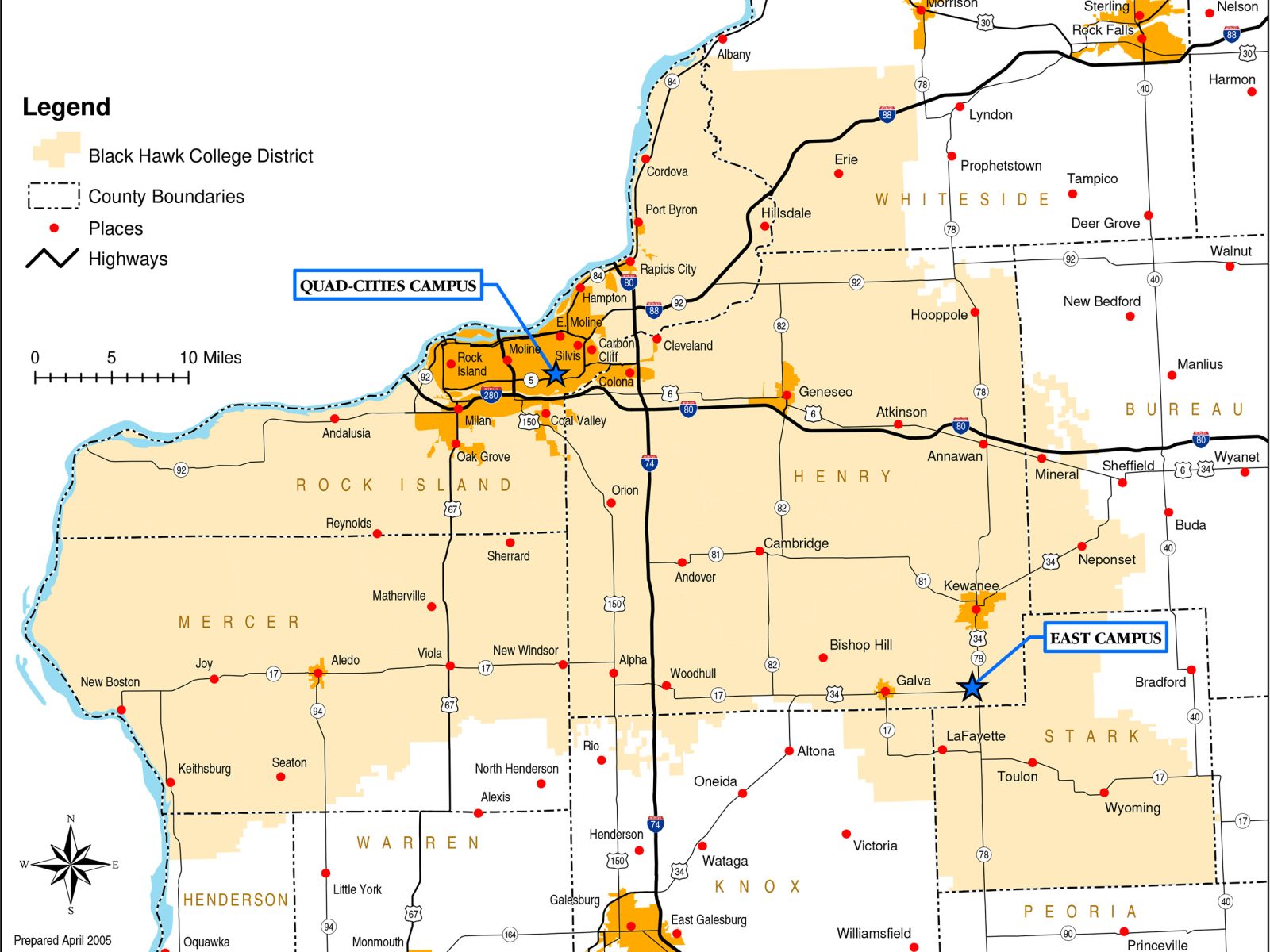
Map of the Black Hawk College District serving communities across western Illinois. The Quad-Cities Campus in Moline and the East Campus near Kewanee are highlighted within the district boundary.
Key Findings
In FY 2023–24, Black Hawk College generated $291.0 million in added income for the BHC Service Area economy.
Our impact supported 3,882 jobs—about one out of every 50 jobs in our Service Area.
Our alumni workforce impact generated $254.5 million in added income and supported 3,183 jobs in FY 2023–24.
Where our annual impact comes from
Our total annual impact is the sum of four components:
- Our operations spending.
- Construction spending.
- student spending.
- Enhanced productivity of our alumni already working in the region.
Annual added income impact by component
Most of our annual economic impact comes from our alumni—people who studied here and now apply their skills in local jobs—followed by our operational footprint (employment and vendor purchasing), construction investment and student spending tied to relocated/retained students.
- Alumni: $254.5M
- Operations: $25.9M
- Construction: $7.6M
- Student spending: $3.0M
Jobs supported by component
When expressed as jobs supported, the study estimates alumni impact supports the largest share of regional jobs, followed by operations, construction and student spending.
What “added income” means
In the study, impacts are reported as added income rather than sales. Added income is a net measure that excludes intermediary costs and money that leaks out of the region, and it is synonymous with gross regional product (GRP)/value added, which is why it’s a more meaningful measure of new economic activity than sales.
How we strengthen the workforce
This study frames us as a supplier of trained workers and shows the largest share of annual impact comes from our alumni already working in the region—meaning our biggest economic contribution is the talent pipeline and productivity we help create.
Alumni impact
In FY 2023–24, the accumulated workforce impact of former students employed in the BHC Service Area amounted to $254.5 million in added income, equivalent to supporting 3,183 jobs.
Students served and staying local

In FY 2023–24, we served 8,087 students (unduplicated headcount). The study estimates 98% of students remain in the BHC Service Area after finishing their time at BHC, with about 1% settling elsewhere in Illinois and 1% out of state.
We also served dual credit students, basic education learners, personal enrichment/youth programming, and workforce/professional development participants—demonstrating a broad workforce and community pipeline beyond degree programs.
Earnings outcomes
The study estimates the average associate degree graduate from FY 2023–24 will see annual earnings $7,100 higher than a person with a high school diploma or equivalent working in Illinois.
How we support jobs and spending as an employer
Our economic footprint isn’t limited to our classrooms. The study describes us as an employer and as a large-scale buyer of goods and services, with spending that ripples through regional businesses.
Employment and payroll
In FY 2023–24, we employed 595 full-time and part-time faculty and staff. Total payroll/payroll and benefits were $28.1 million, and 68% of employees lived in the BHC Service Area.
Operations Impact
During the analysis year, we spent $58.2 million on goods and services to carry out day-to-day and construction operations—supporting regional business activity beyond our payroll. The net impact of our operations spending was about $25.9 million in added income, equivalent to supporting 557 jobs in the region.
More to Explore

News, Events and Blog
Mission and Vision
